Have you ever stopped to think about the lines of code running inside your smart watch? Most of us look at our wrist to see if we hit our ten thousand steps or to check a text message from mom. But for a growing number of people, that little device is doing something much more profound. It is monitoring heart rhythms, detecting falls, and in some cases, calling emergency services before the user even knows something is wrong. This is not science fiction anymore. It is the reality of the health-tech revolution, a field where innovation is not just about making a faster app or a prettier interface. It is about the literal difference between life and death.
We often think of technology as something that makes our lives more convenient. We get our groceries delivered in an hour, we stream movies instantly, and we navigate traffic with ease. But there is a silent army of developers, data scientists, and engineers who are using these same tools to solve the most complex puzzle of all: the human body. In this guide, we are going to dive deep into the world of health-tech, explore why it is currently in such high demand, and see how a few lines of Python or C plus plus can become a lifeline.

The Invisible Heroes of the Operating Room
When we imagine a life-saving scenario, we usually picture a surgeon with a steady hand or a nurse in a high-pressure emergency room. We rarely picture a software engineer sitting in a quiet office with a cold cup of coffee. However, that engineer might have written the algorithm that allows a robotic arm to perform a delicate spinal surgery with sub-millimeter precision. Without that code, the surgery would be riskier, the recovery time would be longer, and the margin for error would be much wider.
Health-tech is unique because it demands a level of perfection that social media or gaming apps simply do not require. If a photo-sharing app crashes, it is a minor annoyance. If a heart-monitoring system has a bug, the consequences are catastrophic. This high-stakes environment is exactly why the industry is booming. Companies are desperate for talent that is not only technically skilled but also deeply disciplined. They need people who understand that every semicolon matters.
Innovation Beyond the Hospital Walls
One of the most exciting aspects of this field is how it is moving healthcare out of the sterile hospital environment and into our daily lives. This is where innovation truly shines. Remote patient monitoring allows doctors to track a patient’s vital signs from miles away. For someone living in a rural area or a patient with a chronic condition, this is a total game-changer. It reduces the need for expensive hospital stays and allows for proactive care rather than reactive treatment.
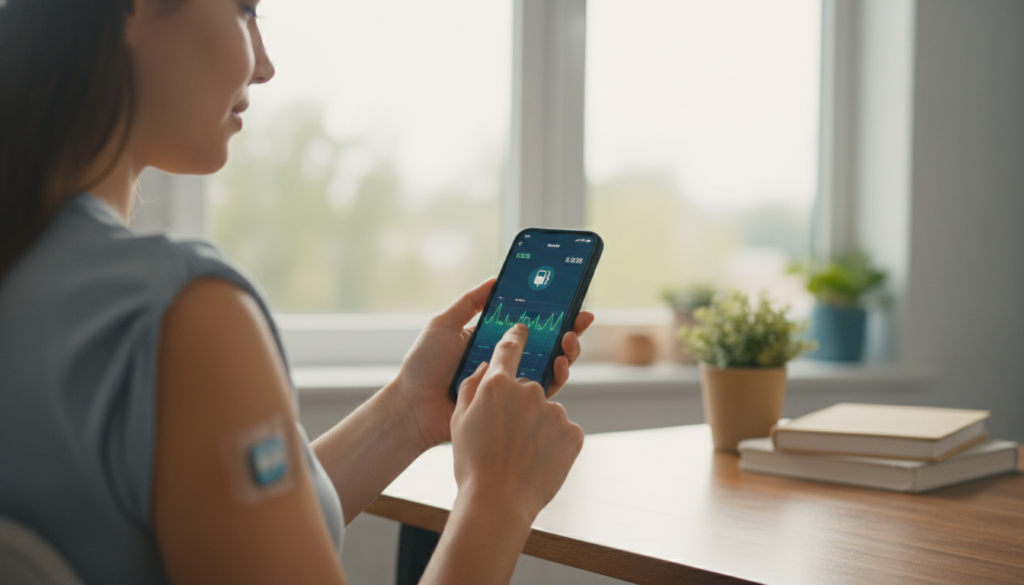
Think about the massive shift we have seen in telehealth. A few years ago, the idea of seeing your doctor through a laptop screen felt like a gimmick. Today, it is a standard of care. Platforms that handle these interactions have to be incredibly secure to protect patient privacy, requiring robust encryption and sophisticated backend architecture. If you are interested in how these systems are built, you can find more resources on tech guides that break down the foundations of modern software development.
The Power of Big Data and AI in Diagnostics
Artificial Intelligence is a buzzword that gets thrown around a lot, but in health-tech, it is delivering on its promises. Imagine a radiologist who has to look at hundreds of X-rays every single day. Fatigue is a human factor that can lead to missed details. An AI model, trained on millions of images, can scan those same X-rays in seconds to flag potential issues that the human eye might miss. It acts as a second pair of eyes that never gets tired.
Companies like Google Health are already making huge strides in using AI to detect early signs of diabetic retinopathy and various forms of cancer. You can explore some of their official research and tools at Google Health. The goal here is not to replace doctors, but to empower them with better data. By automating the routine analysis, we free up medical professionals to focus on what they do best: complex decision-making and patient empathy.
Developing for Accessibility
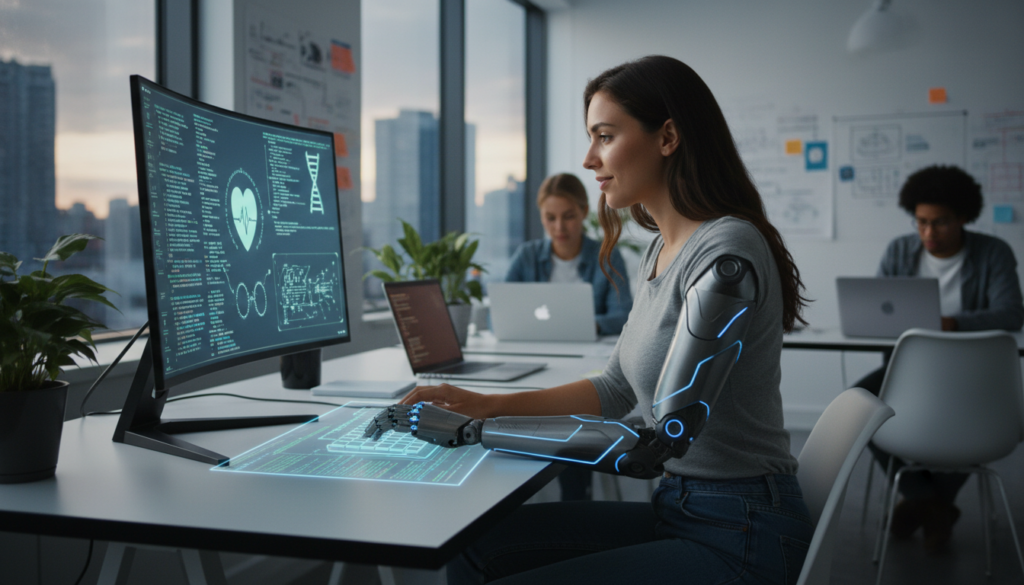
A huge part of this guide to health-tech is understanding that technology must be accessible to everyone. Coding for health means considering users with different abilities. This includes building screen-reader friendly interfaces for the visually impaired or creating simplified navigation for elderly users who may not be digital natives. When we write code that considers these factors, we are making the world a more equitable place. Accessibility is not just a feature; it is a fundamental right when it comes to healthcare.
The Personal Side of the Code
I remember talking to a developer who worked on a pediatric oncology platform. He spent his days optimizing databases and ensuring that data flowed smoothly between different departments. It sounded like a standard tech job until he shared a story about a specific child. Because the system he helped build was so efficient, the doctors were able to identify a specific genetic marker in the child’s tumor days faster than usual. That speed allowed them to start a targeted therapy that saved the child’s life. He told me that knowing his code played a part in that family’s joy was better than any paycheck he had ever received.
That is the heart of health-tech. It is a career path for people who want to see their work have a tangible, emotional impact. It is for the person who loves problem-solving but also cares deeply about human well-being. Whether you are working on a wearable device for Apple Health or developing a new billing system that makes insurance less of a headache for patients, you are contributing to a healthier society.

Getting Started in Health-Tech
If you are a coder looking to make a switch, or a student deciding on a path, here is how you can enter this world. First, you need a strong foundation in data security and privacy laws like HIPAA in the US or GDPR in Europe. Knowing how to protect sensitive information is non-negotiable. Second, get familiar with data science and machine learning. Python is the reigning king of this space due to its incredible libraries for data analysis.
Lastly, don’t forget the human element. Talk to doctors, nurses, and patients. Understand their pain points. The best health-tech solutions don’t come from developers who stay in a bubble; they come from people who listen to the needs of those on the front lines. The demand for these skills is only going to grow as our population ages and our reliance on digital tools increases. It is a challenging field, but the rewards are measured in heartbeats and smiles rather than just clicks and conversions.
Final Thoughts
The intersection of medicine and technology is one of the most exciting frontiers in human history. We are moving toward a future where diseases are caught before they manifest, where surgeries are safer than ever, and where healthcare is a right that is accessible from the palm of your hand. If you have the skills to code, you have the power to change lives. The health-tech world is waiting for your contribution. Are you ready to write the code that saves a life?