
Let’s be real for a second. Picking your first programming language feels a lot like picking your starter Pokémon. Do you go with the fire type (looks cool, burns things), the water type (reliable, versatile), or the grass type (often underestimated but surprisingly powerful)?
When I started coding 25 years ago, we didn’t really have a choice. You learned whatever the cranky professor threw at you, usually C++ or Java, and you spent six months figuring out why you forgot a semicolon. But you? You have options. You have great options.
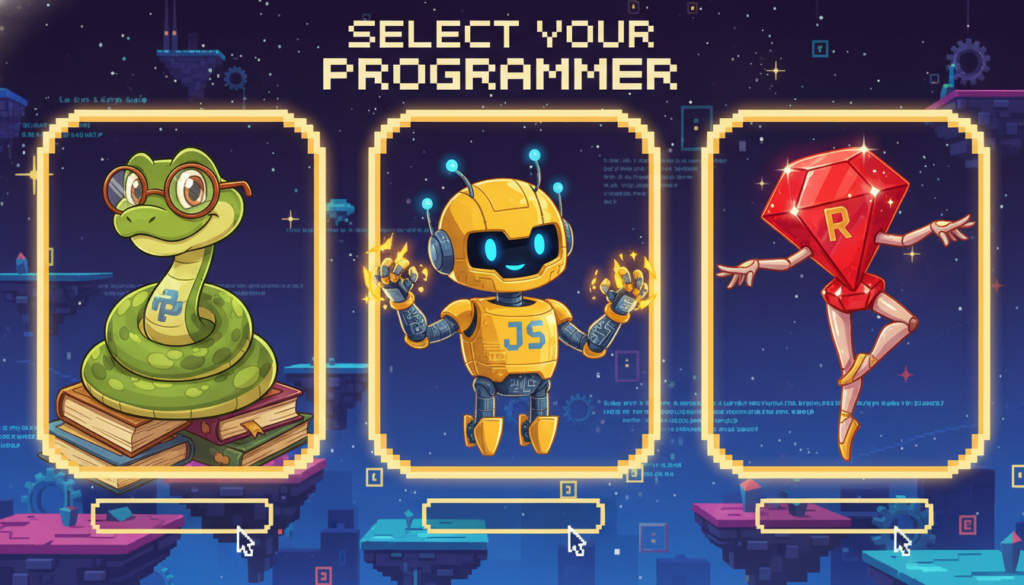
Today, we are looking at the three heavyweights for absolute beginners: Python, JavaScript, and Ruby. These are the languages that won’t make you want to throw your laptop out the window on day one.
Now, before we dive into the code wars, keep in mind that the hardware you use matters just as much as the software you write. If you are coding on a toaster, you are going to have a bad time. For solid advice on gear that won’t break the bank, check out the tech recommendations over at https://beemytech.com/ to make sure your setup is ready for battle.
Alright, let’s meet the contenders.
1. Python: The Friendly Giant
If programming languages were people, Python would be the super-chill librarian who explains everything in plain English and somehow knows the answer to every question you have. Created by Guido van Rossum (a legend), Python was designed with one main goal: readability.
When you look at Python code, it almost looks like you are reading a sentence. There are no curly braces `{}` to panic over, and you don’t need to end every line with a semicolon. It forces you to write clean code by using indentation (spaces) to organize things.
Why You Should Choose Python
First off, it is the language of the future. You have heard of AI, right? ChatGPT, self-driving cars, face recognition? That is almost entirely powered by Python. Libraries like PyTorch and TensorFlow have made Python the undisputed king of Data Science and Artificial Intelligence.
But it is not just for the brainy stuff. You can build websites with it using frameworks like Django or automate boring stuff like renaming 1,000 files on your computer in five seconds.
The Pros:
- Reads like English: You spend less time decoding symbols and more time solving problems.
- Massive Community: If you get stuck, someone on the internet has already solved your problem.
- Versatility: Web dev, data analysis, robotics. It does it all.
The Cons:
- Speed: It can be slower than languages like C++, but for a beginner, this does not matter one bit.
- Mobile: It is not great for making mobile apps (iOS/Android).
If you are interested in the data side of things or just want the smoothest learning curve, Python is your best bet. We actually have some advanced guides on setting up Python environments over at https://beemytech.com/ if you decide to go down the snake path.
2. JavaScript: The King of the Web
JavaScript (JS) is the chaotic good character of the coding world. It is everywhere. I mean literally everywhere. If you are reading this on a browser right now, JavaScript is making it happen.
Unlike Python, which runs on a server or your computer, JavaScript runs directly in the web browser. This means you can write a line of code and immediately see a button change color, an animation fly across the screen, or a popup annoy your user.
Why You Should Choose JavaScript
If you want to build websites, you literally have no choice. JavaScript is one of the three core technologies of the web (along with HTML and CSS). You can’t escape it. But the cool thing is, once you learn it, you can become a full-stack developer.
With tools like Node.js, you can use JavaScript on the server (backend) too. And with libraries like React, developed by Facebook, you can build massive, complex web applications like Instagram or Netflix.
However, fair warning: JavaScript is a bit… weird. It was written in about 10 days back in the 90s, and sometimes it shows. It will happily let you add a word to a number and give you a result that makes no sense. But that flexibility is also what makes it powerful.
The Pros:
- Instant Feedback: You write code, refresh the browser, and boom-magic happens.
- Job Market: Every company with a website needs a JavaScript developer.
- Community: Resources like MDN Web Docs are incredible for learning.
The Cons:
- The “Weird Parts”: It has some quirky behaviors that can confuse beginners.
- Fatigue: There are a million new tools coming out every week (React, Vue, Svelte, Angular). It can be overwhelming.
If you are visually creative and want to show your friends something cool on their phone immediately, go with JavaScript. For more depth on navigating the chaotic web ecosystem, our further reading section at https://beemytech.com/ is a goldmine for filtering out the noise.
3. Ruby: The Artist’s Choice
Ah, Ruby. Ruby is the language designed for developer happiness. I know that sounds like marketing fluff, but it is true. The creator, Yukihiro Matsumoto (Matz), literally said he wanted to make coding fun.
Ruby is most famous for a framework called Ruby on Rails. This framework is legendary. It allowed small teams to build massive startups like Airbnb, GitHub, and Shopify in record time. It does a lot of the heavy lifting for you, assuming you want to build things a certain way.
Why You Should Choose Ruby
Ruby code reads like poetry. It is elegant. If Python is clean, Ruby is beautiful. It is fantastic for beginners because it hides a lot of the complex computer science stuff so you can focus on building your product.
If you have a startup idea—like a lemonade stand delivery app or a social network for hamsters—Ruby on Rails is the fastest way to get it from your brain to the internet. It is an “opinionated” language, meaning it tells you exactly how you should structure your files. This is great for beginners who suffer from decision paralysis.

The Pros:
- Speed of Development: You can build a prototype faster in Rails than almost anything else.
- Friendly Community: The Ruby community is known for being incredibly nice to newbies. “Matz is nice so we are nice” is their motto.
- Elegance: The syntax is just lovely to look at.
The Cons:
- Popularity: It is not as “hyped” as it was 10 years ago. Python and JS have overtaken it in raw numbers.
- Performance: It can be slower at a massive scale (but do not worry about this until you are the size of Twitter).
So, Which One Do I Pick?
Okay, deep breath. I know that was a lot of info. Let’s break it down into a simple decision tree.
1. Choose Python if: You are interested in Data Science, AI, or you just want the easiest syntax to learn the basics of logic. It is the safest bet for a general education in coding.
2. Choose JavaScript if: You want to make websites, games, or visual things. You want to share a link with your friends and say, “I made this.” You are okay with things being a little messy sometimes.
3. Choose Ruby if: You want to build a full business or product quickly. You value beautiful code and a supportive community over raw popularity.
The Most Important Advice I Can Give You
Stop worrying about picking the “wrong” one.
The concepts you learn in one language translate to the others. If you learn loops in Python, you will understand loops in JavaScript. The logic is the same; only the spelling changes. The biggest mistake beginners make is spending 6 months deciding which language to learn and 0 minutes actually coding.
Download a code editor-I recommend VS Code or the AI-enhanced Cursor-and just start typing.
And hey, if you find yourself needing more advanced guides on structuring your projects or choosing the right peripherals to avoid carpal tunnel (seriously, look after your wrists), keep checking back with us at https://beemytech.com/ for the latest insights.
Pick one. Stick with it for 30 days. Build something terrible. Then fix it. That is the only way to become a programmer. Good luck, and welcome to the chaos!