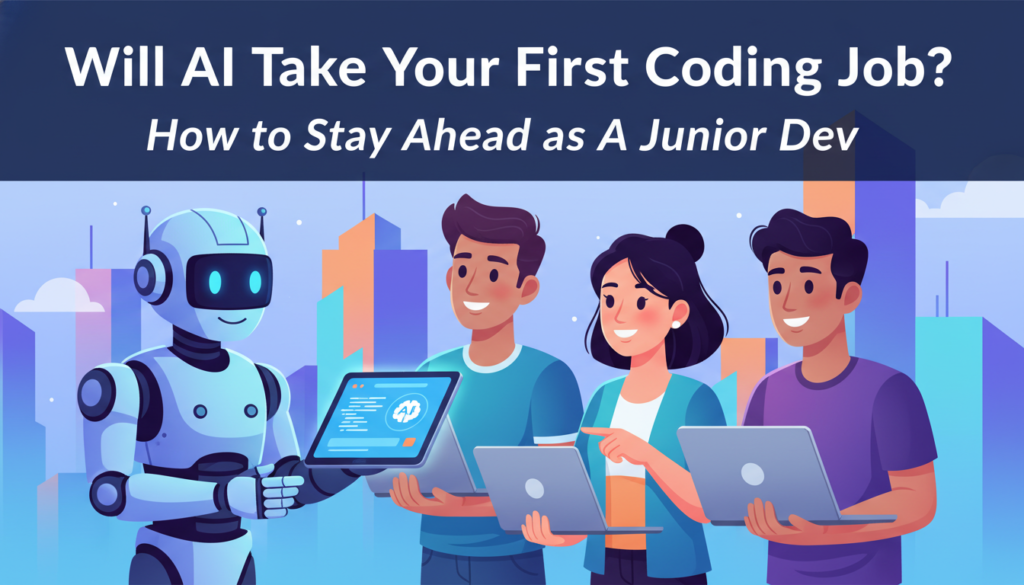
The Big Question: Is the Junior Dev Role Dying?
If you have spent any time on tech Twitter or Reddit lately, you have probably seen the headlines. AI is writing code. ChatGPT is passing Google coding interviews. Large Language Models (LLMs) are building entire websites from a single prompt. If you are 15 or 18 years old and just starting to learn Python or JavaScript, it is natural to feel a bit of a chill down your spine. You might be asking yourself: Is there even a point to this? Will there be a job for me when I finish my degree or bootcamp?
I have been in this industry for 25 years. I have seen the rise of the internet, the mobile revolution, and the cloud era. Every single time a major shift happens, people claim that developers will become obsolete. But here is the truth: we do not have fewer developers today than we did in 1999. We have millions more. AI is not the end of the junior developer; it is the evolution of the role. Let us dive into why you should stop worrying and start building.

Why AI Cannot Replace a Human Engineer (Yet)
First, we need to distinguish between coding and software engineering. Coding is the act of writing syntax that a machine understands. AI is incredibly good at this. If you ask ChatGPT to write a function that reverses a string in Python, it will do it perfectly in two seconds. If that is all you think a junior developer does, then yes, that job is at risk.
However, software engineering is about solving problems using technology. It involves understanding what the user actually needs, which is often different from what they say they want. It involves making trade-offs between speed and security. It involves debugging a weird edge case that only happens when a user on an old version of Safari clicks a button twice during a lunar eclipse. AI does not have context or empathy. It does not know why a business decision was made. It only knows patterns in data.
The 80-20 Rule of AI Coding
AI can get you 80 percent of the way there very quickly. It can generate the boilerplate, the basic CSS, and the standard API calls. But that last 20 percent? That is where the real work happens. That last 20 percent is where the bugs hide, where the security vulnerabilities live, and where the user experience is polished. Companies do not hire juniors just to type; they hire them to learn how to handle that last 20 percent.

How the Junior Role is Changing
In the past, a junior developer might spend their first six months doing small tasks like fixing typos in the UI or writing basic unit tests. Today, AI can do those things. This means the entry bar has moved higher. You are no longer competing against other juniors to see who can remember the syntax for a for-loop. You are competing to see who can use AI to build things faster and better.
From Code Monkey to Code Pilot
Think of AI as a co-pilot. If you are learning to fly a plane, having an autopilot does not mean you do not need to learn how to fly. It means you can focus on navigation and weather patterns instead of just keeping the wings level. As a junior, you need to master tools like GitHub Copilot or Cursor. If you can do the work of two developers by using AI effectively, you are not replaceable; you are a 10x junior.

How to Make Yourself Irreplaceable
If you want to ensure you have a long, lucrative career, you need to focus on the things AI is bad at. Here is your roadmap to becoming an indispensable asset to any tech team.
1. Master the Fundamentals
AI makes mistakes. It hallucinates. It suggests libraries that do not exist or uses deprecated functions. If you do not understand the fundamentals of data structures, algorithms, and how the web works, you will not be able to spot these mistakes. You will be a slave to the AI’s output. But if you know why things work, you can audit the AI’s code and fix it. That makes you the supervisor, not the replacement. To get started on these basics, you can check out resources on our Home page.
2. Focus on Communication and Soft Skills
Coding is a team sport. You have to talk to product managers, designers, and customers. You have to explain why a feature is taking longer than expected. You have to mentor others and participate in code reviews. AI cannot sit in a meeting and navigate the office politics of why the marketing team wants a giant spinning logo on the homepage. Your ability to communicate clearly is your greatest superpower.
3. Build Real Projects with Real Users
Stop doing the same ‘To-Do List’ tutorials that everyone else is doing. AI can build a To-Do list in its sleep. Instead, find a real problem in your community and solve it. Maybe your local animal shelter needs a better way to track donations. Maybe your school needs an app for the cafeteria menu. When you build for real users, you encounter real-world messiness that AI cannot handle. This experience is what hiring managers look for.
- Problem Solving: Can you take a vague idea and turn it into a working feature?
- Domain Knowledge: Do you understand the industry you are building for?
- Adaptability: How fast can you learn a new framework when the current one becomes obsolete?
The Future is Bright for ‘AI-Native’ Developers
You have an advantage that I did not have when I started. You are an AI-native. You are growing up with these tools. Just as the previous generation became faster by using Google and Stack Overflow, you will become faster by using LLMs. The demand for software is not shrinking; it is exploding. Every company is becoming a tech company, and they all need people who can bridge the gap between human needs and machine code.
Do not be afraid of the tool. Master it. Use it to build bigger, more ambitious projects than were ever possible for a solo developer ten years ago. If you want to Learn More about how to navigate the tech landscape, keep exploring and keep building. The world does not need more people who can follow instructions; it needs more people who can think, create, and lead.
Final Thoughts for the 10-20 Age Group
You are at the perfect age to ride this wave. While older developers might be stuck in their ways, you can be flexible. Start a GitHub repository today. Fork a project. Ask an AI to explain a complex concept to you, then try to explain it back to a friend. The future of development is not about being a human calculator; it is about being a human architect. And trust me, the view from the top is great.