The Secret Sauce of the Self-Taught Developer
So, you have spent the last six months fueled by coffee and sheer willpower. You have conquered JavaScript loops, navigated the treacherous waters of CSS Grid, and finally understood why everyone on the internet is obsessed with React. You are ready. You have the projects, the GitHub green squares, and the determination of a caffeinated squirrel. But then you look at a job description and see a list of things that are not code. They call them soft skills. If you are a young tech enthusiast between 10 and 20 years old, you might think, wait, I thought this was a coding job. Why do they care if I am good at talking?
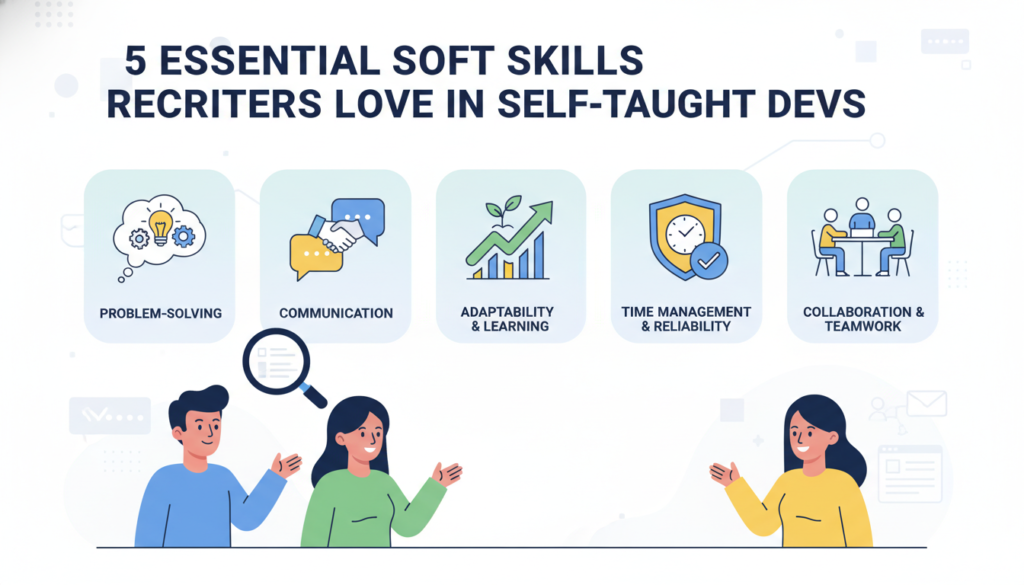
Here is the reality check: companies do not just hire code-writing robots. They hire people. As a self-taught developer, you are already proving you have the grit to learn alone. But to cross the finish line and get that first paycheck, you need to show recruiters that you can play well with others. These soft skills are often the deciding factor between two candidates who both know how to build a basic API. Let us break down the five most important soft skills that will make you a recruiter’s dream candidate.
1. Communication: The Ability to Translate Nerd to Human
Communication is not just about being chatty. In the tech world, it is about your ability to explain complex technical concepts to people who might not know the difference between a backend server and a toaster. Recruiters are looking for developers who can explain their code without making everyone else in the room feel like they need a dictionary. Think of it as the Mom Test. If you can explain your latest project to your grandmother and she understands why it is cool, you have mastered this skill.
In a professional setting, this looks like writing clear comments in your code on GitHub or explaining a bug to a project manager. When you are in an interview, do not just say it works. Explain why you chose a specific solution. Use simple analogies. This shows the recruiter that you understand the big picture and can work with marketing, sales, or design teams without a translator. Good communication reduces errors and keeps projects moving fast, which is exactly what every manager wants.

If you want to Learn More about how to present yourself to employers, check out our resources at Home. Communication also extends to your written presence. Your emails, your Slack messages, and even your README files tell a story about how you think. If your writing is messy and disorganized, recruiters might assume your code is too. Keep it professional, clear, and friendly. It is a small change that makes a massive impact on your hireability.
2. Problem-Solving: Not Just Googling for the Answer
Wait, is not problem-solving a technical skill? Not exactly. While the solution might be technical, the approach is a soft skill. Recruiters want to see your logic. They want to know what you do when you hit a wall. Do you throw your laptop out the window, or do you break the problem down into bite-sized pieces? As a self-taught developer, your greatest strength is your ability to find answers yourself. You have likely spent hours on Stack Overflow or documentation pages. This shows persistence.
The Power of Why
When a recruiter asks you about a challenge you faced, they are looking for your process. They want to hear how you identified the root cause of an issue. Instead of saying I searched for the error and found a fix, say I analyzed the error logs, isolated the function causing the crash, and tested three different solutions before finding the most efficient one. This shows a structured mindset. It proves that you do not just copy-paste code but that you actually understand the logic behind the solution. This kind of critical thinking is rare and highly valued.

Real-world problem solving also means knowing when to ask for help. It sounds counterintuitive, but a developer who grinds for three days on a problem that could have been solved in five minutes by asking a senior developer is actually a liability. Showing that you know how to balance independent research with collaborative help shows maturity. It tells the recruiter that you value the company’s time as much as your own.
3. Adaptability: Embracing the Constant Change
The tech world moves at the speed of light. Today’s hottest framework could be tomorrow’s legacy code. Recruiters love self-taught developers because, by definition, you are adaptable. You taught yourself something from scratch. That is a superpower! However, you need to show that you are willing to let go of what you know to learn what is necessary for the team. If a company uses Vue but you only know React, are you willing to switch? If they need you to jump into a mobile app project even though you are a web dev, do you say yes with a smile?
Adaptability also means handling feedback without getting defensive. In your first job, your code will get torn apart in code reviews. It is not personal; it is about making the product better. Recruiters look for candidates who see critiques as free lessons rather than insults. During an interview, if they suggest a different way to do something, do not argue. Instead, say That is an interesting approach, I had not considered that. How does that affect performance? This shows you are flexible and ready to grow.
4. Collaboration: Playing Well with the Team
The image of a lone coder in a dark basement is a myth. Software development is a team sport. Even if you are the only developer at a startup, you are still working with founders, users, and customers. Recruiters need to know that you are not a lone wolf who refuses to follow the pack. They look for signs of empathy and teamwork. Can you understand someone else’s perspective? Can you help a teammate when they are stuck? This is why contributing to open-source projects is so valuable. It proves you can work within an existing system and follow community guidelines.
When you talk about your projects, use the word we if you worked with others, or explain how your work would benefit a team. Recruiters often use behavioral questions like Tell me about a time you had a conflict with a coworker. They do not care about the drama; they care about how you resolved it. Did you find a compromise? Did you keep things professional? Being a nice person to work with is often more important than being the best coder in the world. No one wants to hire a genius who makes the rest of the team miserable.

5. Humility and Trainability: The Ego-Free Developer
This is perhaps the most overlooked skill for self-taught developers. Sometimes, when we learn something on our own, we feel like we have to prove we know everything to be taken seriously. The truth is, recruiters know you do not know everything. They do not expect you to. What they do expect is for you to be aware of your limitations. A developer who says I do not know the answer to that, but here is how I would find it is infinitely more hireable than one who tries to fake it.
Humility means being okay with being the least experienced person in the room. It means being hungry to learn from those around you. When you show a recruiter that you are coachable, you are telling them that you are a long-term investment. They are not just hiring who you are today; they are hiring who you will become in two years under their guidance. Stay curious, stay humble, and keep that student mindset forever. If you are ready to take the next step in your career, you can always find more tips at Learn More.
Closing Thoughts: You Are More Than Your Code
Being a self-taught developer is a badge of honor. It shows you have discipline, passion, and a high ceiling for growth. But do not let your technical skills be the only thing on your resume. By focusing on communication, problem-solving, adaptability, collaboration, and humility, you turn yourself into a well-rounded professional that any recruiter would be lucky to hire. Remember, the code gets you the interview, but the soft skills get you the job. Keep building, keep learning, and most importantly, keep being a person people want to work with. You have got this!