You finish your shift at 5 PM. Your brain feels like it has been through a blender, and all you want to do is melt into the couch and watch something that requires zero cognitive effort. But there is a nagging voice in the back of your head. It is the voice that wants more: more creative freedom, a better salary, and a career in technology. Learning to code while working a full-time job is one of the most challenging things you will ever do, but it is also one of the most rewarding. In this guide, we are going to talk about how to navigate this journey without losing your sanity or your job.
The first thing we need to address is the elephant in the room: time. You do not have much of it. Between commuting, meetings, and personal responsibilities, your day is a jigsaw puzzle of obligations. This is why you need a strategy rooted in technology and innovation rather than just brute force. If you are looking for more resources on how to navigate the modern tech landscape, check out our latest tech guides at Bee My Tech. Understanding the path forward is half the battle won.

Shift Your Mindset from Sprinting to Long-Distance Running
Most people fail at learning to code because they treat it like a weekend project. They spend sixteen hours on a Saturday building a basic HTML page, get a massive dopamine hit, and then do nothing for two weeks because they are exhausted. This is the fastest way to quit. Instead, you must treat coding like a long-distance run. Consistency is much more valuable than intensity when you are working 40 hours a week.
Think about it this way: if you code for just one hour every single day, you have logged 365 hours in a year. That is more than enough to become proficient in a stack. The goal is to make coding a non-negotiable part of your identity, like brushing your teeth. You do not think about whether you have the energy to brush your teeth; you just do it. Your brain needs to view syntax and logic in the same way.
The Power of the 15-Minute Rule
There will be days when you truly do not have an hour. On those days, use the 15-minute rule. Tell yourself you will only look at your code for fifteen minutes. Usually, once you open the editor and start fixing a bug, you will stay for forty-five. If you really are too tired, you stop after fifteen minutes, but you have kept the habit alive. Keeping the momentum is the secret sauce to innovation in your own learning process.
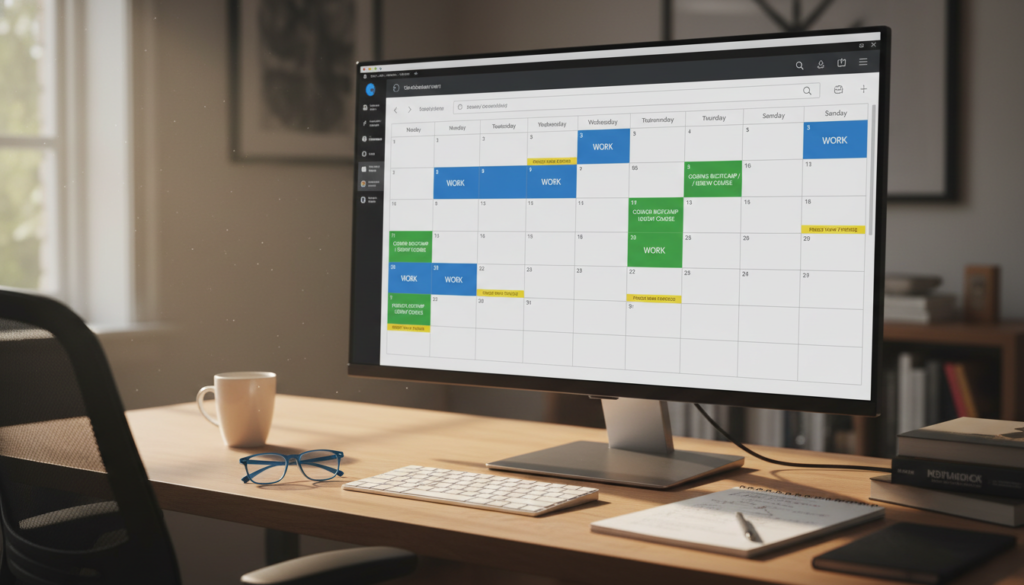
Mastering Your Calendar and Energy Management
Managing time is easy: managing energy is hard. If you are a morning person, waking up an hour earlier to code before work might be your best bet. Your brain is fresh, the house is quiet, and you have not been drained by corporate emails yet. If you are a night owl, you might prefer the 9 PM to 11 PM slot. The key is to find your peak cognitive window and guard it with your life.
You also need to leverage your commute. If you take the train, that is prime time for reading documentation or watching conceptual videos. If you drive, listen to tech podcasts. You are not going to learn to write a React hook while driving, but you can learn the theory behind state management. This constant immersion keeps the concepts top-of-mind so that when you finally sit down to type, you are ready to go.
Creating a Distraction-Free Environment
When you have limited time, you cannot afford distractions. Put your phone in another room. Close the fourteen tabs of YouTube you have open. Deep work is the only way to grasp complex programming concepts. This is where real innovation happens in your brain: when you allow yourself to get into a flow state without the pings of social media interrupting your logic.https://www.youtube.com/embed/8dWL3wF_OMw
Choosing the Right Curriculum and Avoiding Tutorial Hell
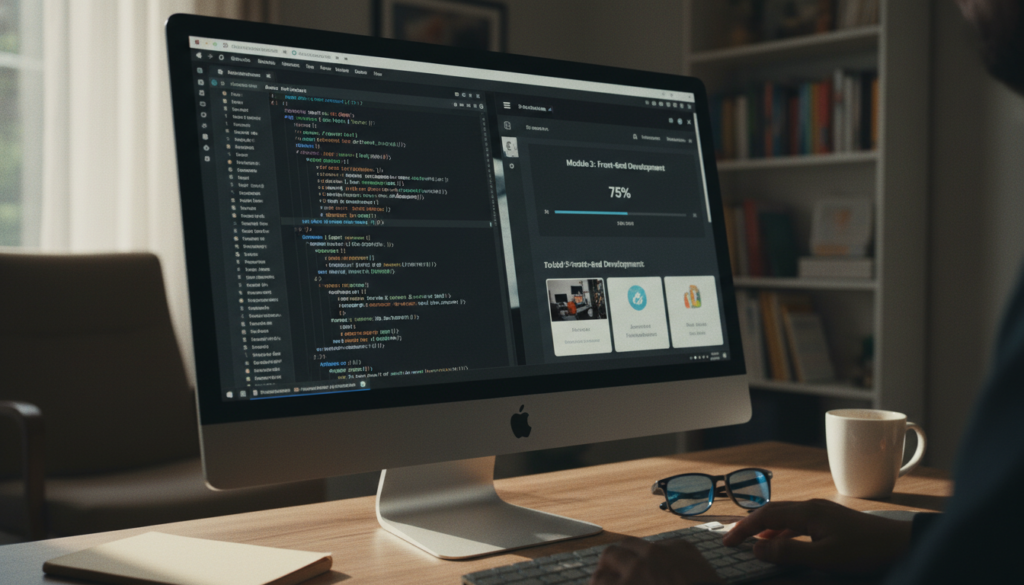
One of the biggest traps for new coders is “Tutorial Hell.” This is when you watch video after video, following along with the instructor, and you feel like a genius. But then you close the video, open a blank text editor, and realize you cannot even remember how to link a CSS file. To avoid this, you need a project-based curriculum.
I highly recommend starting with structured, reputable platforms that force you to build. FreeCodeCamp is a fantastic, free resource that provides a clear roadmap. Another incredible option for a more holistic approach is The Odin Project, which teaches you how to use a real development environment from day one. These resources emphasize doing over watching, which is how you actually learn.
Focus on One Language at a Time
Innovation in technology happens fast, and it is tempting to try to learn Python, JavaScript, and Rust all at once. Do not do that. Pick one path and stick to it until you can build a full-stack application. If you want to build websites, focus on the Holy Trinity: HTML, CSS, and JavaScript. If you want to get into data science, focus on Python. Jumping between languages is a recipe for confusion and slow progress.
Building a Portfolio While You Work
You do not need to wait until you are an expert to start building things. In fact, you should be building from week two. Your portfolio is your resume in the tech world. Since you are working a full-time job, you might not have time for twenty small projects. Instead, aim for three high-quality, unique projects that solve a real problem. Maybe it is a tool to automate a boring task at your current job, or a specialized tracker for a hobby you love.
Document your journey. Writing about what you learned on LinkedIn or a personal blog not only helps solidify the information but also attracts recruiters. It shows that you have the discipline to learn a difficult skill while maintaining a professional career, which is a trait every employer wants to see.

The Mental Game: Dealing with Burnout and Imposter Syndrome
There will be weeks where you feel like you are not smart enough for this. You will hit a bug that takes four days to fix, and you will want to throw your laptop out the window. This is normal. Coding is hard. That is why it pays well. When you feel burnout creeping in, take a full weekend off. The code will still be there on Monday. Your brain needs rest to process the complex patterns you are feeding it.
Remember that every senior developer you admire once spent three hours crying over a missing semicolon. Imposter syndrome never truly goes away: you just get better at managing it. Surround yourself with a community, whether it is on Discord, Twitter, or local meetups. Knowing that others are struggling with the same concepts makes the mountain feel much smaller.
Conclusion: The Path Forward
Learning to code from scratch while working 40 hours a week is a marathon of grit. It is about those quiet nights when you chose your code editor over Netflix. It is about the lunch breaks spent reading about APIs. It is about the refusal to stay stagnant in a career that does not fulfill you. By prioritizing consistency, managing your energy, and choosing the right projects, you are not just learning a skill: you are innovating your entire life. Stay focused, keep building, and remember that the only way to fail is to stop.