
Why Prompting is Your New Superpower
Remember when we used to spend four hours scrolling through Stack Overflow just to find out we missed a semicolon? Yeah, those days are lowkey over. With the rise of AI tools like ChatGPT and Claude, the way we build software has changed forever. But here is the thing: the AI is only as smart as the person talking to it. This is where prompt engineering comes in.
Think of an AI as a super-fast intern who has read every book on Earth but has zero common sense. If you give them a vague instruction, they will give you a messy result. If you give them a clear, structured query, they will build you a masterpiece. In this guide, we are going to dive into how you can write better queries to get better code, making your dev life 10x easier. If you want to Learn More about tech trends, keep reading!
The Core Secret: Context is Everything
The biggest mistake new developers make is being too brief. If you just type write a login page into a prompt, you might get a generic HTML file that looks like it belongs in 1998. You need to provide context. Who is the code for? What language are you using? What styling library do you prefer?
The Pizza Analogy
Imagine you are ordering a pizza. If you just say give me food, you might get a cold salad. If you say I want a large pepperoni pizza with extra cheese and no onions, you get exactly what you want. Prompting for code is the exact same. You need to specify the framework (like React or Vue), the styling (Tailwind CSS or Bootstrap), and the functionality (API integration or state management).

The Persona Technique: Give the AI a Job
One of the coolest hacks in prompt engineering is assigning a persona to the AI. Instead of just asking for code, tell the AI who it should be. For example, you can start your prompt with: You are a Senior Full-Stack Developer with 10 years of experience in React and Node.js.
Why does this work? It sets the tone and the quality level of the response. When the AI thinks it is a senior dev, it will likely include error handling, comments, and cleaner logic that a junior dev might forget. It is like turning on a pro mode switch inside the software.
Few-Shot Prompting: Show, Don’t Just Tell
Sometimes, words aren’t enough. If you have a specific coding style or a weird data structure you need to work with, use Few-Shot Prompting. This just means giving the AI a couple of examples before asking it to do the main task.
- Example 1: Here is how I format my API responses: [Insert Code].
- Example 2: Here is how I handle my state: [Insert Code].
- The Task: Now, write a new function for user profile updates following this same style.
By providing these examples, you are training the AI on your specific vibe in real-time. This ensures the code it generates fits perfectly into your existing project without you needing to refactor everything.
The Chain of Thought: Breaking it Down
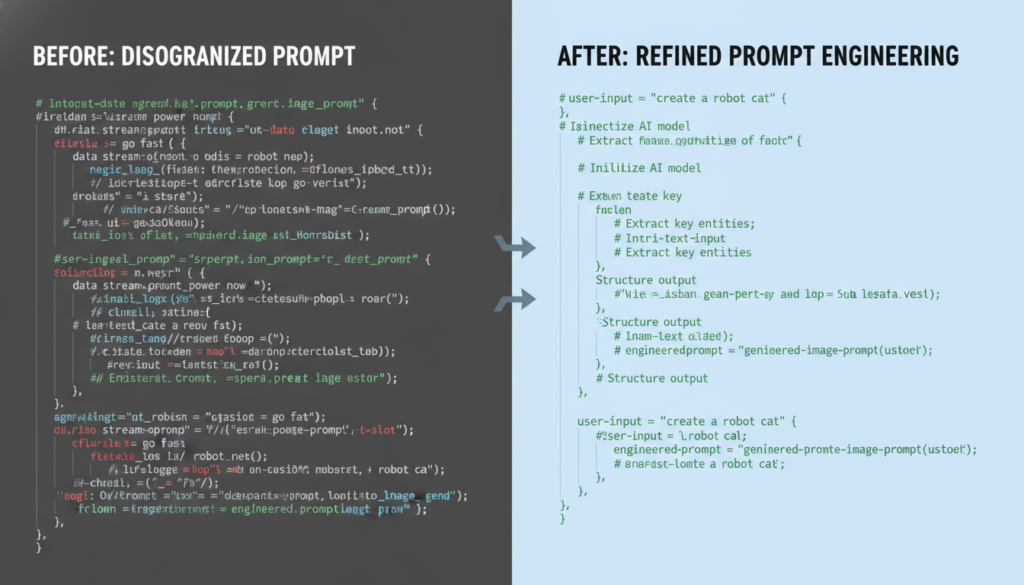
Have you ever asked an AI to build a whole app and it just… broke? That is because complex tasks overwhelm the model. The Chain of Thought technique involves breaking your request into smaller, bite-sized steps. Instead of asking for a whole e-commerce site, ask for the product list component first. Then ask for the shopping cart logic. Then ask how to connect them.
You can even tell the AI: Let us think step-by-step. This simple phrase forces the AI to plan its logic before it starts typing code, which significantly reduces bugs and logical errors. It is a total game-changer for building complex features.
Debugging Like a Boss
We have all been there. You copy-paste code, and it throws a massive red error in your console. Most people just paste the error into ChatGPT and hope for the best. To do it better, provide the Error, the Code that caused it, and what you were Trying to achieve.
Pro Tip: If you don’t understand the fix, ask the AI to explain it to you like you are five. This helps you actually learn the concepts instead of just being a copy-paste developer. Understanding the why is what separates the average coders from the ones who get the high-paying jobs.

Security First: What Not to Prompt
Before you get too excited, let us talk about safety. Never, ever paste sensitive info into an AI. This includes:
- API Keys: Your secret keys for things like Stripe or AWS.
- Passwords: Even if they are just for testing.
- Private Company Data: If you are working on a secret project, keep the data generic.
AI models can sometimes use your inputs for training (depending on your settings), and you don’t want your private keys showing up in someone else’s chat. Be smart, stay safe, and always use environment variables in your real code.
The Future is Collaborative
Prompt engineering isn’t just a trend; it is a fundamental shift in how we interact with technology. As AI gets better, your ability to communicate with it will become more valuable than your ability to memorize syntax. But remember, the AI is a co-pilot, not the captain. You still need to know the basics of programming to verify that the AI isn’t hallucinating or giving you insecure code.
By mastering these techniques, you are setting yourself up to be a modern developer who works smarter, not harder. You can build projects faster, learn new languages in days instead of months, and spend more time on the creative parts of tech that you actually love.
Wrapping Up
Writing better queries is a skill that takes practice, just like gaming or playing an instrument. Start small, experiment with different personas, and don’t be afraid to tell the AI it made a mistake. If you want to keep leveling up your skills, head over to Home and explore our latest tech guides.
The world of AI-assisted coding is wide open. Whether you are building the next big social media app or just a simple calculator for your homework, these prompt engineering tips will help you get there faster. Now, go open up GitHub Copilot and start building something epic!