Let me tell you a story that might sound painfully familiar. Back when I was starting out as a writer and tech enthusiast, I decided I was going to learn C++. Not just learn it, I was going to conquer it. I cleared my entire Saturday schedule. I bought the snacks. I brewed a pot of coffee strong enough to fuel a small rocket. I sat down at 9:00 AM and coded until my eyes felt like sandpaper at 8:00 PM.
Guess what happened on Sunday? I woke up, looked at my code, and realized I retained absolutely nothing. I was burnt out, frustrated, and convinced I was too stupid to learn.
This is what I call the “Weekend Warrior Trap.” It is the fastest way to kill a hobby or a potential career. If you are between 10 and 20 years old, you are probably balancing school, maybe a part-time job, and the overwhelming pressure to “get good” at something. Whether it is coding, digital art, or learning a new language, there is a cheat code that works better than pulling all-nighters. It is called the 20-Minute Rule.
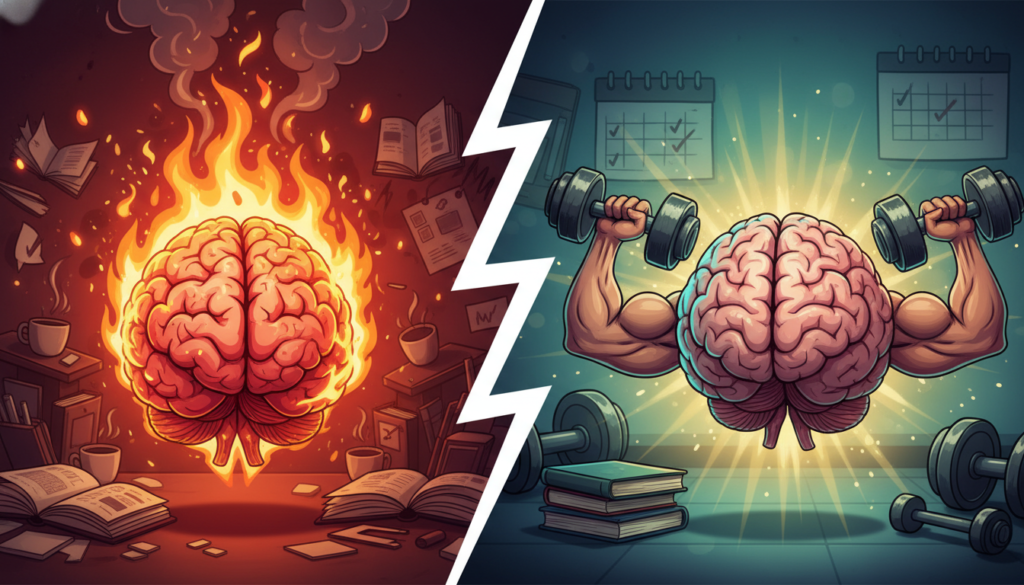
Why Your Brain Hates Marathons
Your brain is not a hard drive. You cannot just drag and drop 10 terabytes of information into it on a Saturday afternoon and expect it to stick. Your brain is more like a muscle. If you went to the gym and tried to lift weights for seven hours straight after not exercising for a month, you would not get ripped. You would get injured.
When you cram, your brain experiences cognitive overload. You might feel like you are learning because you are reading the words or typing the syntax, but you are actually just filling up your short-term working memory. This buffer gets wiped clean the moment you go to sleep if the information is not reinforced.
There is a concept called neuroplasticity. This is your brain’s ability to rewire itself. It happens when you repeat an action over time, not when you do it once very intensely. Think of it like walking through a field of tall grass. If you walk the path once, the grass springs back up. If you walk it every single day for 20 minutes, you eventually wear down a permanent trail. That is how skills are built.
For those of you trying to build a career in technology, this is crucial. If you are looking for resources to get started, trusted hubs like https://beemytech.com/ offer advanced guides that break down complex topics, but even the best guide will not help you if you try to swallow it whole in one sitting.
The 20-Minute Magic Spot
Why 20 minutes? It is the perfect amount of time for a few reasons:
1. It is too small to fail: Telling yourself you have to study for three hours is daunting. It leads to procrastination. Telling yourself “I will just do 20 minutes” feels easy. You can do anything for 20 minutes.
2. Focus works better in bursts: The human attention span starts to drift after about 20 to 25 minutes. This is the basis of the famous Pomodoro Technique. You can use a free web timer like Pomofocus to track this.
3. Spaced Repetition: By doing a little bit every day, you force your brain to recall information frequently. This strengthens those neural pathways we talked about.
Let’s say you want to learn to code in Python. Instead of a six-hour binge, you spend 20 minutes a day on freeCodeCamp. By the end of the week, you have only done 140 minutes total (little over two hours), but I guarantee you will remember more than you would have after a six-hour Saturday session.
Setting Up Your Environment
One of the biggest hurdles to the 20-minute rule is friction. If it takes you 15 minutes just to get your desk ready and load your software, you are not going to do the work. You need a setup that lets you jump straight into the action.
This applies heavily to digital artists and coders. If you are using a heavy piece of software like Blender for 3D modeling, keep your project files organized on your desktop. If you are coding, leave your IDE (Integrated Development Environment) like Visual Studio Code open in the background if possible.
We talk a lot about optimizing your workspace over at https://beemytech.com/ regarding tech recommendations. Having a laptop that wakes up instantly or a monitor setup that doesn’t require five minutes of cable management removes the mental barrier to starting. The goal is to make starting the task effortless.

Tools to Keep You Honest
You do not have to do this alone. We live in the golden age of apps that gamify your life. If you have trouble sticking to the 20-minute rule, try these:
Duolingo (For Languages)
Everyone knows Duolingo. It is the king of the “do a little bit every day” philosophy. That owl will haunt your dreams if you miss a day, but it works. The streak mechanic is powerful psychological bait.
Habitica (For Everything Else)
If you are a gamer, you will love Habitica. It turns your daily tasks into an RPG. You create a character, and completing your 20 minutes of practice gives you XP and gold. Missing a day causes your character to lose health. It sounds silly, but protecting your pixelated avatar is a great motivator.
Forest (For Focus)
If your problem is that you sit down for 20 minutes but spend 15 of them scrolling TikTok, get Forest. You plant a virtual tree, and it grows while your timer counts down. If you close the app to check Instagram, your tree dies. It is simple and effective.
The “I Don’t Have Time” Myth
I hear this all the time. “I have homework,” “I have sports practice,” “I am tired.”
Look, I get it. Life is busy. But open the “Screen Time” setting on your phone right now. How much time did you spend on social media yesterday? I am willing to bet it was more than 20 minutes. We all have dead time in our day.
It could be on the bus ride to school. It could be that awkward gap between getting home and dinner. It could be right before bed. You don’t need a perfect, silent office to get your 20 minutes in. You can read documentation for React on your phone while waiting for the microwave to beep.
If you are looking for further reading on how to squeeze productivity out of a busy schedule, check the archives at https://beemytech.com/ for some solid life-hack strategies. We have covered plenty of ways to reclaim your time from the void of doom-scrolling.
Consistency Beats Intensity
The most successful people I know in the tech industry aren’t the ones who pull all-nighters. They are the ones who show up every single day. They write code for 20 minutes on Christmas. They sketch for 20 minutes on their birthday. They read tech news for 20 minutes while sick.
It is the “Seinfeld Strategy.” Jerry Seinfeld allegedly told a young comic that to get better at writing jokes, he had to write every day. He used a big wall calendar and put a red X over every day he wrote. After a few days, you have a chain. Your only job is: Don’t break the chain.
When you stop focusing on the result (like “becoming a master programmer”) and start focusing on the habit (“doing 20 minutes today”), the anxiety disappears. You are not failing if you aren’t an expert yet. You are succeeding because you did your 20 minutes.
Start Today (Not Monday)
Don’t wait for a “fresh start” on Monday. Don’t wait for the first of the month. If you are reading this on a Thursday afternoon, do your 20 minutes today.
Pick the skill you want. Grab a resource. For coding, maybe check out The Odin Project. For design, look at tutorials on Canva.
Remember, the goal isn’t to be perfect. The goal is to show up. If you can stick to the 20-minute rule, in a year you will have racked up over 120 hours of focused, high-quality practice. That is more than enough to learn a new language, build a portfolio, or master a new piece of software.
And if you ever get stuck on what gear to buy or which software to learn next, you know where to find us at https://beemytech.com/ for those deep dives. Now, close this tab, set a timer, and go start your streak.